
Provably Fair Cryptographic Verification and Seed Checks
 Available in US
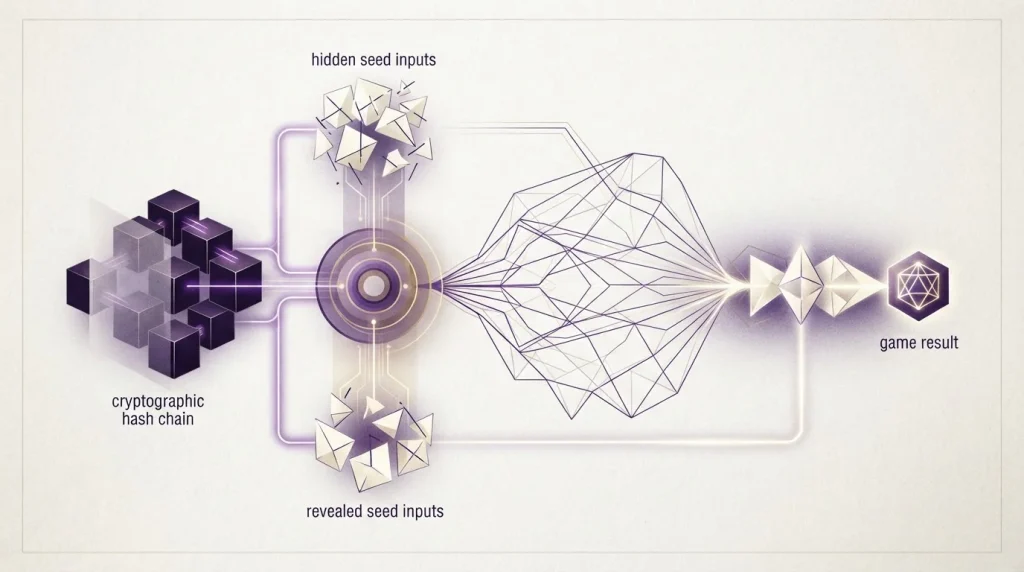
Result-level verification
CryptoSlots reports provably fair verification across its proprietary game library. The useful idea is simple: a cryptographic commitment is made before or around a game round, and the player can later use the revealed data to check whether the recorded outcome matches that commitment. This improves result transparency, but it does not remove house edge, variance or gambling risk. Before testing cryptographic seed hashes with real crypto stakes, explore the three-tier CryptoSlots welcome bonus to claim extra promotional funds.
- CoverageReported across all CryptoSlots games
- Game modelIn-house proprietary catalog
- Library sizeAbout 100 games
- RTP disclosureNo visible game-by-game table found in reviews
Table of Contents
- Cryptographic Round Verification, Seed Inputs and Hash Checks
- A verification check should be repeatable from recorded round data
- Hashes commit to data before the result is revealed
- A verifiable round can still come from a game with a house edge
- Cryptographic transparency does not reduce the financial risk of gambling
- The feature matters more because CryptoSlots builds its own games
- Questions worth answering before relying on provably fair verification
- Use CryptoSlots provably fair verification as an integrity check, not a profitability signal
Cryptographic Round Verification, Seed Inputs and Hash Checks
The core promise of a provably fair system is reproducibility. Instead of asking a player to trust that the casino server produced a result honestly, the system supplies cryptographic information that can be checked after the round. If the revealed inputs reproduce the same outcome, the result is consistent with the earlier commitment. That distinction matters because “fair” can mean several different things in gambling. Provably fair does not mean every player gets an even chance of profit. It does not mean the house edge disappears. It does not mean short sessions will converge neatly toward a theoretical return. It means the outcome can be checked against a cryptographic process.Integrity question
Did the result match the committed data and verification method?Probability question
What is the underlying chance of each outcome and the long-run house edge?Bankroll question
How much short-term variance can your balance absorb before you stop?A verification check should be repeatable from recorded round data
The exact screen labels can differ from game to game, but the verification logic follows a recognizable sequence. You capture the relevant round data, compare the committed value with the revealed inputs, then reproduce the result through the casino’s verifier or the documented algorithm.- Record the round identifier and fairness data. Keep the hash, seed references or equivalent values associated with the game round.
- Note the result before changing anything. Verification works best when you preserve the round as it appeared rather than relying on memory later.
- Reveal or retrieve the underlying seed data when the system allows it. The purpose of the earlier hash is to show that the committed input was not silently swapped after the result.
- Run the verification. The checker should reproduce the same game result from the disclosed inputs.
- Compare the reproduced result with the recorded round. A match supports integrity of that round; a mismatch is the point at which you preserve evidence and investigate further.
Hashes commit to data before the result is revealed
A cryptographic hash acts like a one-way fingerprint of an input. If the underlying seed changes, the hash changes as well. In a provably fair design, that lets the system commit to data before the player sees the final outcome, then reveal enough information later for the player to reproduce and compare the result.| Stage | What you see | What it helps establish |
|---|---|---|
| Before or around the round | Hash or commitment reference | The underlying input is fixed before final verification |
| After reveal | Seed or verification inputs | The committed data can be checked |
| Verification | Reproduced outcome | The recorded result matches the disclosed cryptographic process |
A verifiable round can still come from a game with a house edge
Independent reviews did not find a visible game-by-game RTP table for CryptoSlots. That is why result verification and expected return should remain separate in your analysis. A hash check can tell you whether a specific result matches the inputs, but it does not by itself reveal the full probability distribution behind thousands or millions of rounds.Provably fair can show
- The committed data matches the revealed data
- The recorded result can be reproduced
- The round was not silently rewritten after the fact
Provably fair does not show by itself
- The long-run RTP of every game
- Your chance of finishing a session ahead
- How volatile the next series of outcomes will be
Cryptographic transparency does not reduce the financial risk of gambling
A verified losing result is still a loss. The technology can reduce uncertainty about whether an individual outcome was altered, but it cannot protect a bankroll from house edge, variance, chasing behavior or poor session limits. That boundary is especially important in crypto gambling because the payment rail adds its own volatility and irreversible-transfer risk on top of ordinary casino risk.- Set a loss limit before play rather than using the verifier as reassurance to continue.
- Treat each verification check as an integrity test, not as evidence that future rounds will improve.
- Keep crypto-price movement separate from gambling results when judging what a session actually cost.
- Stop if verification becomes part of chasing losses or repeatedly trying to prove that a run “should” reverse.
The feature matters more because CryptoSlots builds its own games
CryptoSlots is not relying on a third-party provider ecosystem to supply most of its game trust signals. The catalog is in-house, which makes the operator’s own verification system more central to how a player evaluates the games. With roughly 100 proprietary titles, the same basic fairness concept can be learned once and applied across the library. This creates a coherent model: one studio, one proprietary catalog, and a common cryptographic verification idea. It also concentrates responsibility. When there is no roster of external studios, the player has fewer independent game-provider brands to use as a shortcut for familiarity. The verifier therefore becomes one of the main technical tools for judging round integrity.Consistency helps learning
A repeated verification pattern across proprietary titles can make it easier to build a routine around checking results.Transparency remains narrow
The verifier speaks to specific outcomes. It should not be stretched into claims about long-run profitability or complete mathematical disclosure.Questions worth answering before relying on provably fair verification
Are all CryptoSlots games provably fair?
What does provably fair verification prove?
Does provably fair mean there is no house edge?
Is provably fair the same as RTP disclosure?
Why should I verify ordinary rounds?
Use CryptoSlots provably fair verification as an integrity check, not a profitability signal
The strongest use of CryptoSlots’ provably fair system is narrow and practical: verify that a recorded result matches the cryptographic data committed around that round. That is valuable transparency, especially in a fully proprietary game library. It should not be confused with a promise of favorable odds, a published RTP table, or a way to predict future outcomes. The verifier can tell you whether the process reproduces the result; responsible limits still determine how much financial risk you take. Check out full banking methods and game rules in our comprehensive CryptoSlots casino review.Recommend

Proprietary Casino Slots and Provably Fair Game Catalog
CryptoSlots Proprietary game library CryptoSlots has roughly 100 proprietary games rather than a large third-party...

CryptoSlots VIP Loyalty Program and Weekly Cashback Terms
CryptoSlots Cashback and loyalty mechanics CryptoSlots separates its loyalty mechanics from the welcome offer: weekly...

CryptoSlots Casino Welcome Package and Wagering Rules
CryptoSlots Welcome-offer analysis The stable welcome structure is split across the first three deposits: 111%...

Cryptocurrency Payment Methods and Cashier Rules
CryptoSlots Crypto deposits and withdrawals CryptoSlots is crypto-only and supports seven assets: BTC, ETH, LTC,...

CryptoSlots Casino Licensing and Player Protection Info
CryptoSlots License and player-protection context CryptoSlots states that it is licensed and registered in the...

Player Account Registration and Identity Verification
CryptoSlots Account access and verification CryptoSlots uses a crypto-only account model with no mandatory upfront...