Proprietary Casino Slots and Provably Fair Game Catalog
Updated November 2026
Licensed
 Available in US
Fast payouts
18+ Only

Proprietary game library
CryptoSlots has roughly 100 proprietary games rather than a large third-party provider lobby. Slots form the core, with video poker, keno, specialty games and progressive-jackpot content around them. The defining technical feature is provably fair verification across the library, while a real live-dealer section is absent.
- Library sizeAbout 100 proprietary games
- Provider modelIn-house only
- Fairness featureProvably fair across the library
- Live dealerNo real live-dealer casino
Table of Contents
- In-House Slots Selection, Proprietary Titles and Game Variety
- An in-house catalog changes how you judge variety and trust
- Slots lead the catalog, with video poker, keno and specialty games around them
- Provably fair verification gives each result a checkable cryptographic trail
- Result verification does not replace published RTP information
- No real live-dealer lobby means table players need to adjust expectations
- Questions that matter before choosing the CryptoSlots game library
- The best fit is players who value verifiability over lobby size
In-House Slots Selection, Proprietary Titles and Game Variety
CryptoSlots is built around roughly 100 proprietary titles. That makes it structurally different from casinos that assemble thousands of games from dozens of outside studios. Here, the operator controls the game catalog rather than acting mainly as a distribution layer for external providers. The upside is consistency. Interface patterns, game logic and verification behavior can feel more coherent when the same studio builds the full catalog. The tradeoff is obvious as soon as you browse by variety: a player looking for a huge provider menu, branded releases or a deep live lobby will find fewer choices than at a large aggregator casino.Breadth stays limited
About 100 titles is enough for recurring play, but it is a compact selection compared with multi-provider casinos that refresh their lobbies with large volumes of third-party releases.Design can stay consistent
An in-house library usually reduces the jump between different vendor interfaces. That can make navigation and verification habits easier to learn across titles.Provider shopping is not the point
There is no roster of outside studios to compare. The choice is mainly whether CryptoSlots’ own catalog and fairness model suit your preferences.An in-house catalog changes how you judge variety and trust
Every title is reported as proprietary to Slotland Entertainment rather than supplied by outside vendors. That removes one common trust shortcut: you cannot judge the lobby by recognizing a long list of well-known studios. Instead, the useful questions are whether the catalog contains the formats you actually play, whether individual results can be checked, and whether the same system behaves consistently across the library.Where the model works well
- Players who prefer a focused catalog over endless browsing
- Players who value result-level cryptographic verification
- Players who are comfortable with an operator-owned game stack
Where the model is narrower
- No broad roster of third-party providers
- No real live-dealer section
- Less variety for players who chase new releases from multiple studios
Slots lead the catalog, with video poker, keno and specialty games around them
The reported mix is centered on slots, with video poker, keno, specialty games and progressive-jackpot content also present. This is a casino-first lineup rather than a broad entertainment lobby. The categories cover several familiar gambling formats, but they do so inside one proprietary ecosystem.| Category | Role in the library | What to expect |
|---|---|---|
| Slots | Core category | Primary content type in the proprietary catalog |
| Video poker | Secondary category | Card-based machine play rather than live tables |
| Keno | Secondary category | Number-draw format within the same in-house system |
| Specialty games | Supporting category | Alternative formats outside the main slot and poker groups |
| Progressive jackpots | Feature layer | Includes the reported $1,000,000 Jackpot Trigger title |
Provably fair verification gives each result a checkable cryptographic trail
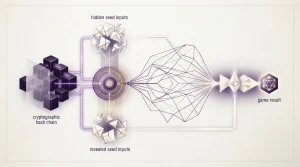
CryptoSlots reports provably fair verification across all of its games. In practical terms, this means game outcomes can be checked using cryptographic hash information rather than accepted only as an opaque server result. That is the strongest technical differentiator in the catalog.- Capture the fairness data around a game round. A provably fair system exposes cryptographic inputs or references that let the player verify the outcome later.
- Complete the round normally. The result still carries ordinary gambling variance and house edge; verification does not change the probability model while you play.
- Use the verification data after the result. The cryptographic check tests whether the disclosed inputs reproduce the recorded outcome.
- Treat verification as an integrity check. It answers whether a result matches the committed data, not whether the game is favorable to the player.
Result verification does not replace published RTP information
Independent reviews did not find a visible game-by-game RTP table. That creates an important boundary in how the fairness feature should be interpreted. A provably fair check can show that a particular round followed the committed cryptographic inputs, but it does not automatically tell you the long-run theoretical return of the game.Provably fairChecks whether a specific result can be reproduced from the cryptographic inputs.
RTPDescribes theoretical long-run return under the game’s probability model.
VarianceDescribes how widely short-term results can move around that long-run expectation.
These are related but separate ideas. A game can be verifiable and still have a house edge. A game can publish an RTP and still produce long losing or winning streaks because short-run results are noisy. The safest reading is therefore technical rather than promotional: verification reduces opacity around individual outcomes, while RTP disclosure would answer a different question about expected value over a very large sample.
No real live-dealer lobby means table players need to adjust expectations
CryptoSlots does not offer a genuine live-dealer casino. That matters because live blackjack, roulette and baccarat serve a different use case from machine-style casino games. They add streamed dealers, scheduled tables and a social layer that a proprietary slots-and-specialty catalog does not replicate. One review used the word “live” as a category label, but the stronger cross-source picture is that there is no actual live-dealer section. The practical consequence is straightforward: choose CryptoSlots for its own game library and provably fair mechanics, not for a studio-style live casino experience.- Use the catalog if proprietary slots and specialty formats are enough for your routine.
- Do not expect streamed dealer tables or a large live lobby.
- Evaluate fairness through the cryptographic verifier rather than through provider reputation alone.
- Keep gambling limits separate from fairness features; a verifiable result can still be a losing result.
Questions that matter before choosing the CryptoSlots game library
How many games does CryptoSlots have?
The consistent cross-source picture is roughly 100 proprietary games. A much larger 4,000+ figure appears as an outlier and is not used here.
Does CryptoSlots use third-party game providers?
No. The library is reported as fully in-house through Slotland Entertainment rather than supplied by outside studios.
Are CryptoSlots games provably fair?
Yes. The game library is reported as provably fair, with player-verifiable cryptographic hash checking of results.
Does CryptoSlots have live dealer games?
No genuine live-dealer casino is reported. The catalog is built around proprietary machine and specialty games instead.
Does CryptoSlots publish RTP for every game?
Independent reviews did not find a visible game-by-game RTP table. Provably fair verification and RTP disclosure answer different questions.